HKUST Announces Blockchain-Inspired DNA Storage Encoder/Decoder: Gungnir – Enables Lossless Recovery of Severely Damaged Sequences, with a 4x Improvement in Error Tolerance
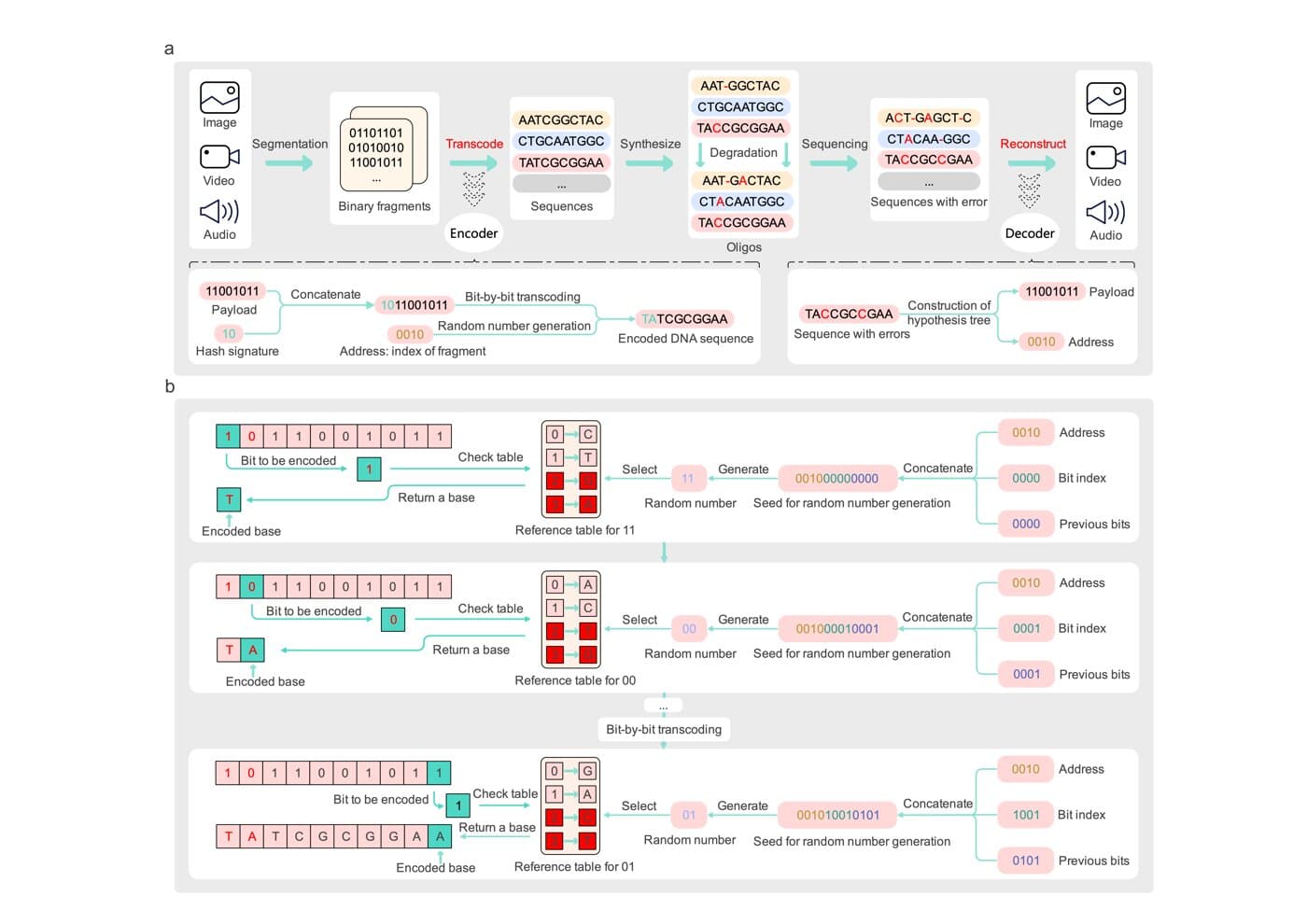
A team from the University of Hong Kong has published a DNA storage encoding/decoding system, Gungnir, in Nature Communications, inspired by blockchain computing. The system generates and validates candidate reconstructions using computational power, achieving an error rate of up to 20% (four times higher than existing methods). In extreme testing simulating 400 years of archival damage, the system successfully recovered data without loss, potentially extending the practical lifespan of DNA archives from less than ten years to several centuries. The code is open-source.
Related tags
##香港大学发布区块链启发 DNA 存储编解码器 Gungnir:能够从严重受损序列中无损恢复数据,容错率提高 4 倍
Hong Kong University engineering faculty research team has developed Gungnir, a DNA data storage codec inspired by blockchain computing, which significantly improves the ability to recover digital information from heavily damaged DNA sequences, potentially extending the practical lifespan of DNA data archives from less than ten years to several centuries. The paper was published in Nature Communications.
The team is led by Professor Ruibang Luo and Professor Can Li at the School of Computer and Data Science and the Department of Electrical and Electronic Engineering, respectively. The project code has been made open source: github.com/HKU-BAL/Gungnir.
Background: DNA storage is promising but “prone to errors”
DNA is a compelling long-term archival storage medium: its small physical size can accommodate vast amounts of information, and it can be stably stored for thousands of years under suitable conditions, with zero energy consumption during storage. The problem lies in the fact that DNA molecules gradually degrade and accumulate damage over time, making it increasingly difficult to recover the original files. Existing codecs perform best on newly synthesized DNA, but their ability to correct errors accumulated over long-term storage is limited.
Core Idea: Trading computing power for error correction capability
Gungnir takes a novel approach to error correction by introducing blockchain computing technology into DNA data storage:
- Generate Candidates: Utilize significant computing power to generate possible reconstructions of the original data
- Verify Iteratively: Continuously verify until the correct information is confirmed.
This means that the stronger the computing power, the better Gungnir’s error correction capability – a stark contrast to traditional error-correcting codes which are limited by their redundancy design.
Test Results
- Error tolerance reaches 20%: This improves the tolerance of DNA storage devices to damage by 4 times compared to existing methods
- Successful recovery after extreme testing: Under expected damage levels after archiving for approximately 400 years, Gungnir still achieves lossless data recovery.
- Future outlook: The practical lifespan of DNA-based storage is expected to be extended from less than ten years to several centuries; with continued growth in computing power, performance can potentially be further improved, ultimately achieving the ability to store digital information in DNA for thousands of years.
Paper and Open Source
- Zhang, J. et al. Gungnir codec enabling high error-tolerance and low-redundancy DNA storage through substantial computing power. Nature Communications (2026). DOI: 10.1038/s41467-026-71485-x
- Open source code: https://github.com/HKU-BAL/Gungnir
More News
Want to see more quality content?
Browse all news