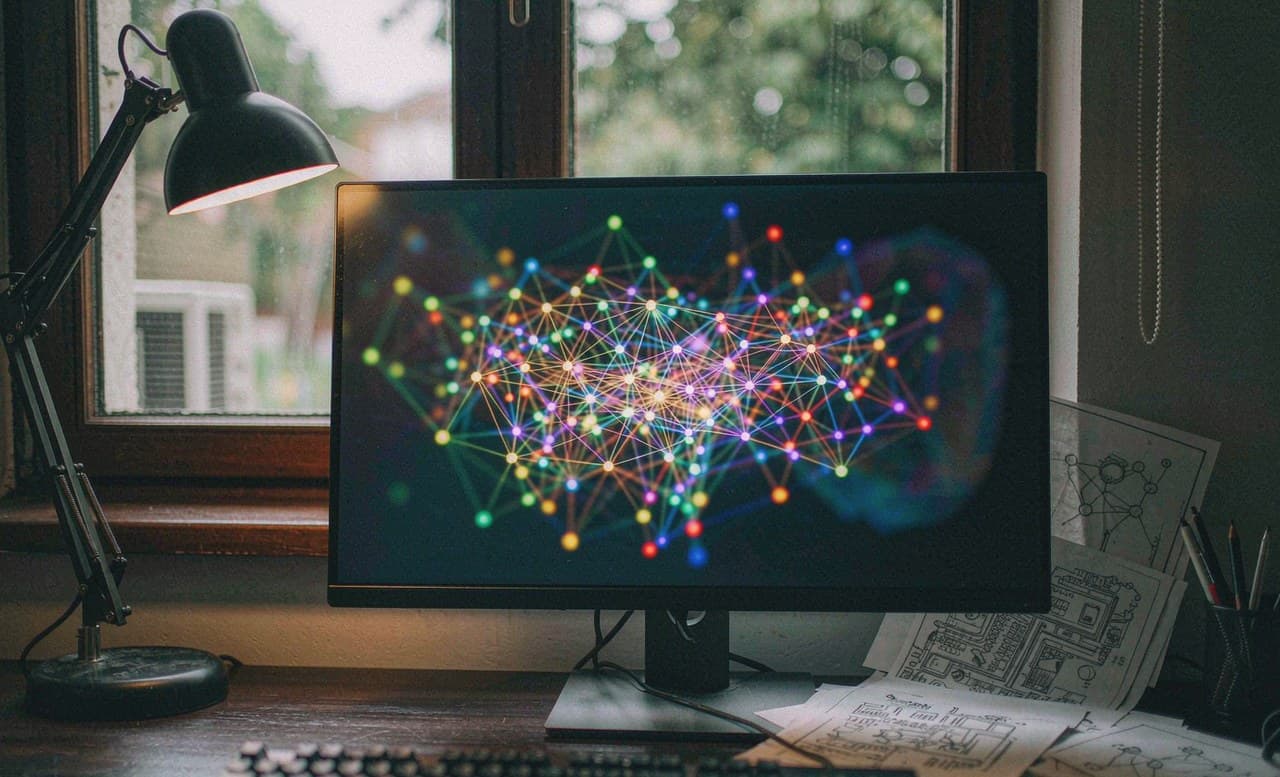
In a single day, Graphify removed its vector library and transformed the entire codebase into an interactive knowledge graph.
Graphify uses a local tree-sitter AST parser to map code, documentation, SQL schemas, and PDFs into queryable knowledge graphs. Each edge is labeled with its source, and the entire process requires no LLM consumption. LOCOMO achieves a recall@10 of 0.497, significantly outperforming mem0's 0.048.
Related tags
Single Day 1,408 Stars: Graphify Abandons Vector Database, Turns the Entire Codebase into an Explorable Knowledge Graph
Summary: Graphify uses a local tree-sitter AST parser to map code, documentation, SQL schemas, and PDFs into a queryable knowledge graph, with each edge labeled with its source. The process consumes no LLM resources. It significantly outperforms mem0's 0.048 recall@10 on the LOCOMO benchmark, achieving 0.497, and reached the top trending spot with 1,408 stars in a single day.
In a landscape where "RAG + vector database" has become almost the standard answer for AI understanding codebases, Graphify-Labs/graphify offers an alternative approach: build a graph without vectors. This YC S26-incubated Python project achieved a surge in popularity today, amassing 1,408 stars in a single day, reaching a total of 133,019 stars and becoming the hottest project on the daily leaderboard.
Its core principle is "replace file-by-file grep with querying." When using an AI coding assistant, you can input /graphify, which maps the entire project – code, documentation, SQL schemas, configuration files, even PDFs, images, and videos – into a knowledge graph. The key design lies in: the code portion is fully processed locally using tree-sitter for AST parsing, ensuring deterministic execution, no LLM calls, and no data leaving your machine; semantic processing of documents and media only uses the model you configure.
Two details highlight the rigor of this project. First, every edge in the graph has a label: EXTRACTED, indicating that the source code explicitly contains it; INFERRED, indicating that it is inferred from the parsing – allowing you to distinguish between what was directly read and what was inferred. Second, it explicitly states "not a vector index": no embeddings, no vector storage, but a truly traversable graph where you can ask questions, trace paths between two things, or explain a concept.
The practical usage involves just two commands: uv tool install graphifyy to install the CLI (note that the PyPI package name is graphifyy, with double "y"), running graphify install to automatically detect and register the assistant you're using, and then entering /graphify . in Claude Code, Cursor, Codex, Gemini CLI, and other 20+ assistants. After about 30 seconds, you get three files: a graph.html that can be clicked, filtered, and searched; a GRAPH_REPORT.md summarizing the key points; and a graph.json for repeated querying without re-reading the source files.
The capabilities include cross-file linking (calls/imports/inherits/mixes_in) covering approximately 40 languages; the Leiden community automatically splits the knowledge graph into sub-systems and labels them as requiring no LLM; code comments like # NOTE:/# WHY:, ADRs, and RFC references become first-class node links to the code.
The benchmark results demonstrate its courage to challenge mainstream narratives. On LOCOMO (n=300), recall@10 reaches 0.497, compared to mem0's 0.048 and supermemory's 0.149; LongMemEval-S QA achieves an accuracy of 76%, matching dense RAG; and the entire knowledge graph construction consumes 0 LLM credits. All comparisons were conducted on the same testing framework, with the same model and budget, resulting in a consistent 90.6% agreement between reviewers.
For developers who work daily with large codebases and agents, Graphify demonstrates that "understanding a project by AI" doesn't necessarily mean breaking down the code into vectors – a clear, interpretable graph may be closer to how human engineers understand code.
Repository link: https://github.com/Graphify-Labs/graphify
More News
Want to see more quality content?
Browse all news