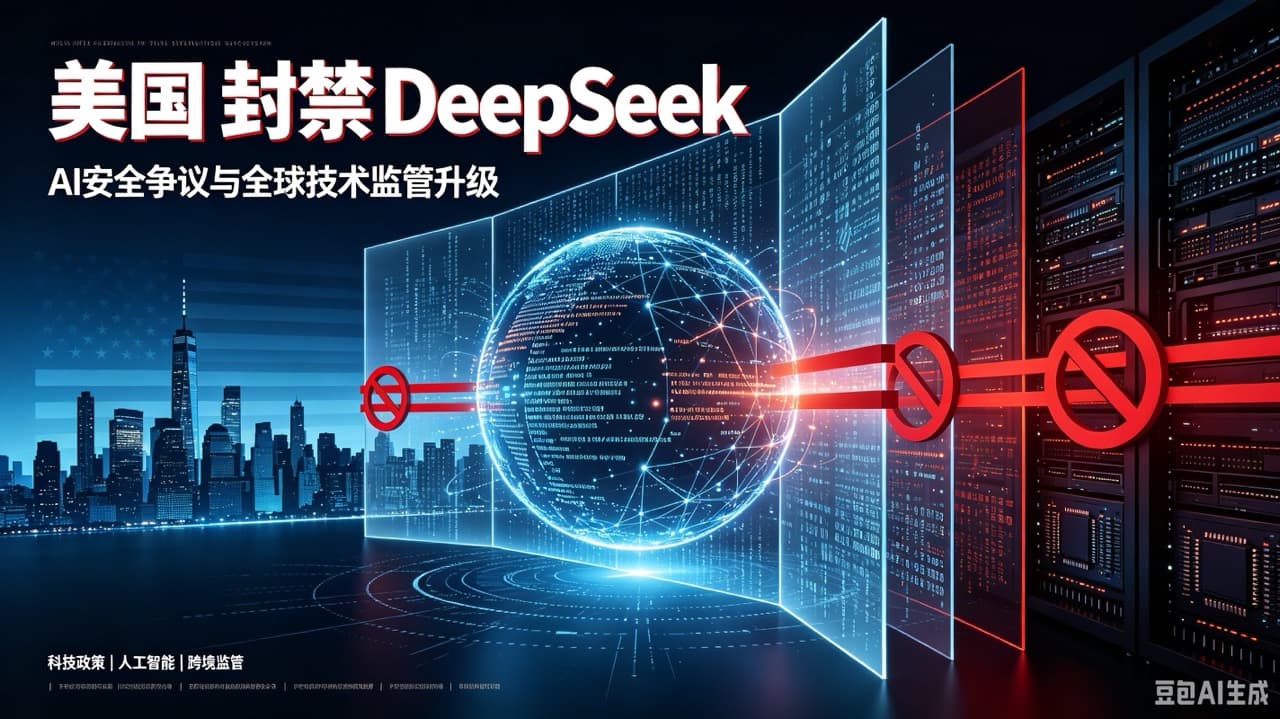
A thunderous clap late at night! OpenRouter has quietly blocked access to the official DeepSeek portal, and is this a sign that the dominant Chinese AI company is being "defeated" by a price war?
A screenshot has surfaced, labeling the official DeepSeek provider as "unroutable." Meanwhile, the US Congress is pushing for a complete ban on large Chinese AI models. Is this restriction simply a business decision?
Related tags
I. What happened? A screenshot stirs the entire AI community
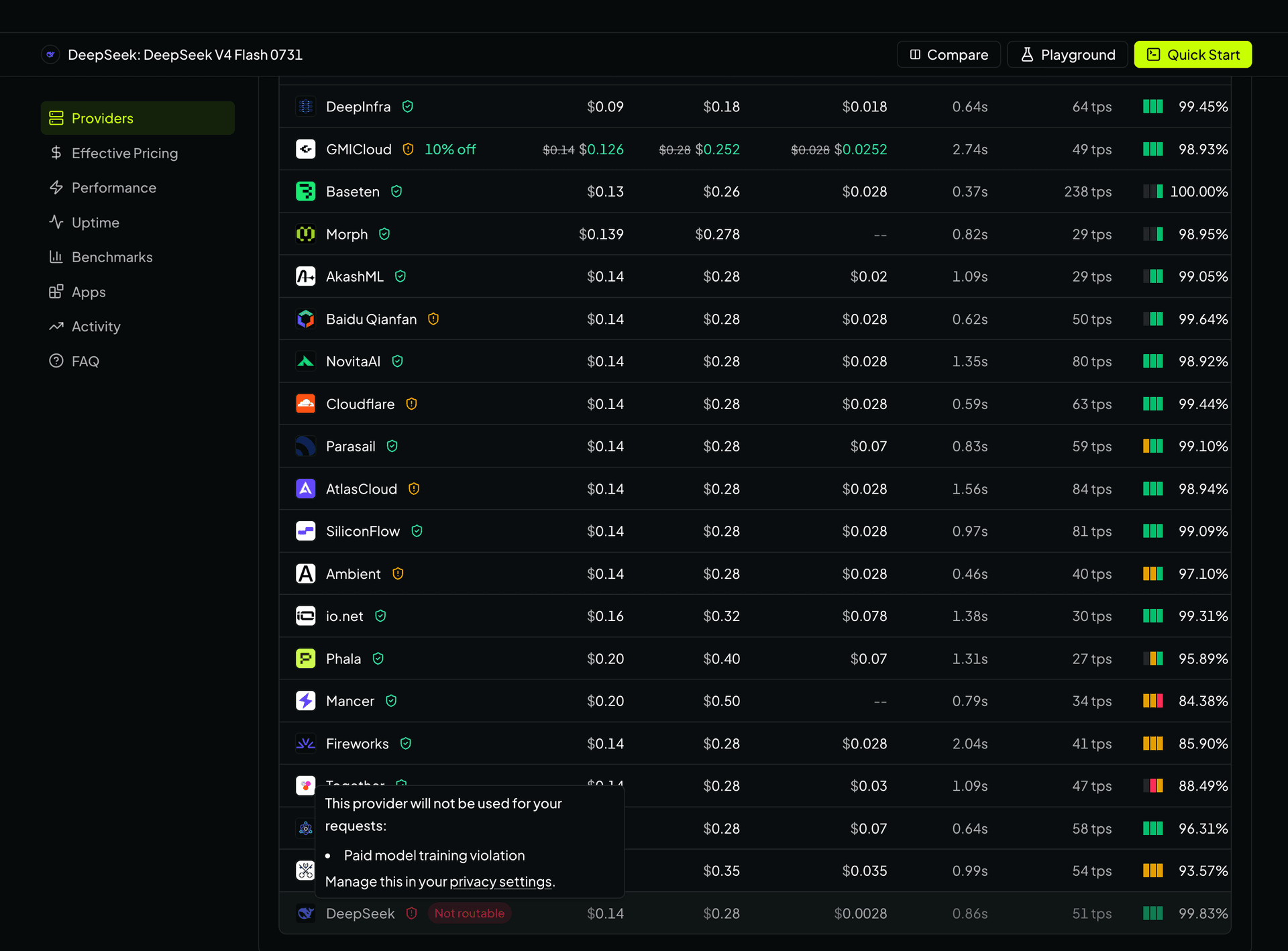
A screenshot from OpenRouter’s console showed that, under a model named “DeepSeek V4 Flash 0731,” the official DeepSeek channel had clearly indicated “Not routable” – clicking on it would pop up a cold message:
“This provider will not be used for your requests: Paid model training violation. Manage this in your privacy settings.”
Translated into plain language, this means: “Want to use this model? No way. Your requests are being routed elsewhere.”
For ordinary users, this means:
- Similarly, calling DeepSeek might become more expensive – third-party intermediaries will profit from the difference.
- The terms of service could be changed unilaterally – the “Paid model training violation” suggests that your data may be used for training.
- Usability would be compromised – the official entry would directly block access, leaving developers without direct control.
II. Why now? DeepSeek has exposed the industry’s vulnerabilities
Looking back at the timeline, DeepSeek launched V3.1 (685B parameter MoE, 37B active) in August of this year, directly slashing industry benchmark prices:
| Model | Input/Output Price (per million tokens) | Relative to DeepSeek |
|---|---|---|
| DeepSeek V3.1 | \(0.14 / \)0.28 | 1x |
| Claude Sonnet 4.5 | \(3 / \)15 (discounted by 67%) | ~21x |
| GPT-4o | \(2.5 / \)10 | ~18x |
| Gemini 1.5 Pro | \(1.25 / \)5 | ~9x |
What does this mean? Using DeepSeek to achieve the same results could cost significantly less than using Claude – a difference of up to 1⁄20. Once V3.1 was launched, DeepSeek instantly became the most popular model on OpenRouter.
Even more dramatically, Anthropic was forced to lower its prices by 67%, and OpenAI followed suit with price adjustments – effectively disrupting the entire Western AI pricing system.
III. A coincidence? The “Ban Chinese AI” bill is also progressing simultaneously
If OpenRouter blocking DeepSeek is simply a “commercial choice,” then this news is truly alarming:
By mid-2025, both parties in the US Congress have reached an agreement and are pushing forward with the “Comprehensive Ban on Chinese Large Models” draft law, requiring all US infrastructure operators (including API aggregation platforms) to prohibit direct access to large models trained by China.
The draft also includes a “soft” clause: allowing operators to re-route requests to non-Chinese original manufacturers if user consent is obtained –
Wait, isn’t this what OpenRouter is doing now?
By blocking the official channel and discreetly diverting traffic to intermediaries such as DeepInfra and GMICloud, they can comply with regulations, earn profits, and appear “neutral.” It’s a win-win situation.
IV. Conspiracy theories: “DeepSeek won’t be able to compete, so let’s block it”
If you still think this is just a commercial matter, I can only say that you are being naive.
Let’s put things together:
- August 2025: DeepSeek V3.1 launches, with a price of 1⁄20 of the industry standard, making OpenRouter the most popular model.
- Q4 2025: Anthropic and OpenAI are forced to significantly lower prices due to pressure, reducing their profit margins.
- Early 2026: The US Congress is pushing forward with the “Ban on Chinese AI” law.
- August 2026: OpenRouter silently marks DeepSeek’s official provider as “Not routable.”
Is this a well-rehearsed script?
“DeepSeek can’t compete, so let’s block it” – This statement is going viral on Twitter and Reddit. Developers are understandably frustrated:
- Why should my API requests be secretly re-routed?
- Why should intermediaries profit from the difference while I think I’m directly accessing the model?
- Why can a US company “erase” an official Chinese AI service without any notice?
Even more deeply, when “neutral infrastructure” starts to filter traffic based on nationality and “price advantages” can be easily eliminated by administrative orders, what remains of the “open API market”?
V. What can developers do?
- Build your own proxy: Directly connect to DeepSeek’s official API endpoint, bypassing aggregation platforms.
- Pay attention to alternative solutions in the EU and Asian markets: Cloud vendors and data center providers in Europe and Southeast Asia are emerging with similar aggregation services.
- Back up your prompt history and fine-tuning weights: Don’t put all your eggs in one basket.
Conclusion
The “Not routable” designation for DeepSeek, on the surface, is a commercial adjustment. However, it’s actually a metaphor for an era:
When AI becomes a national infrastructure, “access” itself becomes political.
What is currently being blocked is DeepSeek’s official channel. Tomorrow, it could be another model that we haven’t even heard of from China. When a price advantage of 1⁄20 can be eliminated by a single marker, the “price competition” will never end – the ultimate goal is not to compete in price, but to determine who gets to speak on someone else’s turf.
As for whether OpenRouter’s actions are “compliant self-regulation” or “cooperation to eliminate,” time will tell.
But one thing is certain: In an era where developers vote with their feet, the game has just begun.
More News
Want to see more quality content?
Browse all news